
Views: 0 Author: Site Editor Publish Time: 2026-06-10 Origin: Site


E-bikes and e-motorcycles can look similar at first glance, but they serve very different riding needs. One is mainly built for assisted cycling, short urban trips, and flexible access to bike-friendly routes. The other is designed as a road-ready electric vehicle with higher speed, stronger power, and greater responsibility for the rider.
The difference affects more than performance. Licensing, registration, insurance, road access, battery range, safety gear, and long-term ownership costs can all change once a vehicle moves from e-bike territory into Electric Motorcycles.
E-bikes usually serve short urban trips, campus movement, low-speed commuting, and routes where bicycle infrastructure already exists. Their value comes from assistance, flexibility, and low daily friction rather than raw speed. A rider can often park near the destination, move through congested areas, and avoid the full ownership process of a motor vehicle. This light-mobility role makes sense when the goal is replacing short car trips.
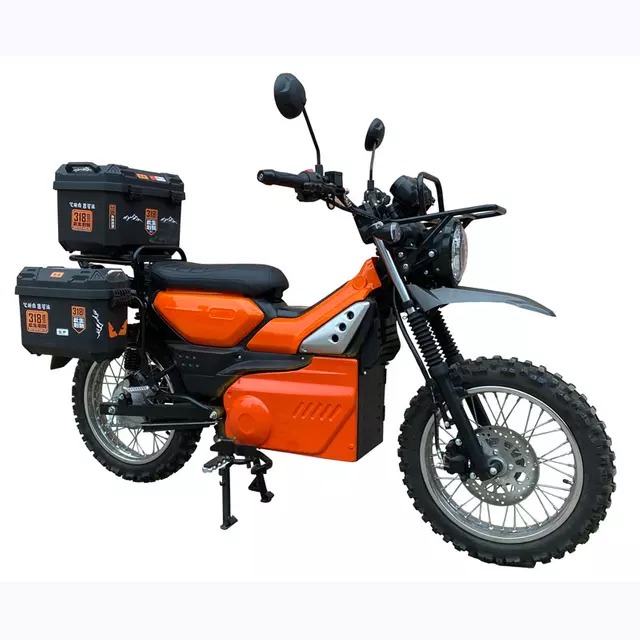
Electric Motorcycles serve a different job. They are built for stronger acceleration, higher cruising speed, heavier rider loads, and roads where traffic moves too quickly for a standard e-bike. HOFAN’s EM-GP1, for example, uses a 2000W/3000W motor and lists a maximum speed of 80–100 km/h, which is far beyond bicycle-style assistance. EM-TVS and EM-CG2 support commuter-style Electric Motorcycles, while EM-MEY and EM-JUF represent higher-output options for riders needing more speed and range.
The performance logic is different from the start. E-bikes help riders move with less effort. Electric Motorcycles help riders participate in road traffic more like a motorcycle. One prioritizes access and simplicity, while the other prioritizes road presence, load capability, and sustained powered travel.

Vehicle category is not decided by motor wattage alone. Frame strength, tire size, brake system, suspension, battery capacity, curb weight, and passenger or cargo expectations all reveal what the product was built to do. A light e-bike frame can feel practical at bicycle speeds, yet the same design would not be the right benchmark for repeated high-speed road riding. Once speed rises, the forces on tires, forks, brakes, and chassis rise as well.
That is why motorcycle-level design matters. Disc brakes, stronger suspension, larger batteries, reinforced frames, and road-focused lighting are not cosmetic details. They support control and durability when speed, weight, and braking distance increase. Across HOFAN’s Electric Motorcycles range, models such as EM-TVS, EM-MEY, EM-JUF, and EM-CG2 list disc brake configurations, supporting their motorcycle-level positioning.
Comparison Point | E-Bike | E-Motorcycle |
Main role | Assisted bicycle-style mobility | Road-ready powered transport |
Typical environment | Bike lanes, campuses, short city routes | Public roads, delivery routes, faster streets |
Priority | Flexibility and easy storage | Speed, load, and road presence |
Component expectation | Bicycle-grade parts for lower speed | Motorcycle-level brakes, tires, frame, and suspension |
Best fit | Short-distance riders | Commuters, delivery riders, recreational road users |
Many buyers confuse e-bikes, e-motos, electric scooters, and Electric Motorcycles because the visual differences can be subtle. A product may have pedals, a bicycle-like seat, or a compact frame, yet still exceed the power or speed limits used by local e-bike rules. Marketing terms such as “street legal,” “off-road mode,” or “electric bike style” do not replace legal classification. Riders should check the actual rule in their market before using any electric two-wheeler on public roads, bike lanes, parks, or shared-use paths.
In the United States, federal discussion of low-speed e-bikes refers to fully operable pedals, an electric motor of less than 750 watts, and a motor-powered speed below 20 mph under defined conditions. State and city rules can add class systems, age limits, helmet rules, or access restrictions. This is why buyers should avoid assuming every electric two-wheeler with pedals is legally an e-bike. The line between a compliant e-bike and Electric Motorcycles can affect fines, liability, insurance coverage, and resale.
When a vehicle is treated as a motorcycle, ownership becomes more formal. Riders may need a driver’s license or motorcycle endorsement, registration, a license plate, insurance, approved lighting, and road-use compliance. Protective gear expectations also rise because the vehicle may travel at traffic speed. A motorcycle-rated helmet, gloves, jacket, and proper footwear match the risk profile of a faster vehicle.
For B2B buyers, classification is not only a rider issue. Importers, dealers, and fleet operators need to confirm whether Electric Motorcycles can be sold, registered, insured, and serviced in the target market. A distributor who markets an overpowered vehicle as an e-bike may face customer complaints when buyers discover licensing or registration requirements after purchase. Fleet managers also need clarity because delivery riders may operate across districts with different enforcement practices.
E-bikes may work well where riders have access to bike lanes, low-speed streets, campus roads, or short urban routes. Some shared-use paths may allow certain e-bike classes, while other areas restrict throttle-assisted or faster models. This flexibility can make an e-bike faster than a more powerful vehicle in dense city centers. A bike-lane route through congestion may beat a standard traffic lane full of stopped cars.
Electric Motorcycles usually belong in standard traffic lanes and on public roads where motorcycles or motor vehicles are permitted. They are more suitable for faster city streets, delivery routes, longer commutes, and areas with limited bicycle infrastructure. The trade-off is clear: e-bikes can win on access, while Electric Motorcycles win when traffic speed and distance demand stronger performance. A buyer should map the actual route before comparing specifications.
A lower purchase price can make e-bikes attractive, yet ownership cost is not limited to the first payment. Buyers should compare battery replacement, tires, brake pads, charger quality, service access, lock systems, and daily storage. Since e-bikes usually avoid registration, mandatory insurance, and license-related costs in many markets, the administrative burden is often lighter. That simplicity is one reason they work well for casual riders and short-distance commuters.
Electric Motorcycles usually involve a larger upfront investment and more formal ownership responsibilities. Registration, insurance, road compliance, motorcycle-grade tires, and stronger brake systems can increase long-term cost. At the same time, those costs support a different kind of vehicle: one designed to carry more load, move faster, and operate more confidently on public roads. The right comparison is not “cheap vs expensive,” but “simple mobility vs motorcycle-level capability.”
Battery capacity affects range, weight, charging habits, and real-world suitability. A smaller battery may be enough for short city loops, while a delivery rider or long-distance commuter needs more reserve capacity. Larger lithium battery configurations can improve range, but they also affect price, vehicle mass, and charging planning. Buyers should ask how far the vehicle must travel on a normal day, not only how far it can travel under ideal conditions.
Storage can decide whether a vehicle feels convenient after the first month. E-bikes are easier to carry indoors, place in apartments, park near offices, or lock at standard bike racks. That advantage matters for riders living in dense housing, dormitories, or cities with limited secure parking. Theft risk still requires serious planning because lightweight electric bicycles can be attractive targets.
Electric Motorcycles need more space and stronger security. A rider may need a dedicated parking area, weather protection, motorcycle-grade locks, or monitored storage. For B2B use, storage becomes a fleet management issue involving charging access, battery care, and overnight security. These details can affect daily satisfaction as much as top speed or range.
Before buying, confirm:
● Local classification and road-use rules
● Required license, registration, and insurance
● Expected route speed and daily distance
● Battery type, range, and replacement support
● Parking space, charging access, and theft prevention
E-bikes often feel natural in low-speed urban areas because they are light, easy to handle, and less intimidating for casual riders. Tight turns, crowded bike lanes, apartment storage, and quick errands all favor a smaller vehicle. Pedal assist also allows riders to add effort when they want exercise or save battery on flat routes. In neighborhoods, campuses, and dense city centers, flexibility can matter more than top speed.
The limitation appears when surrounding traffic moves much faster. A rider traveling at bicycle speed on a 45–55 mph road may feel exposed, especially when cars pass with a large speed difference. Better infrastructure can reduce this pressure, but not every city has protected bike lanes or low-speed routes. If the regular route includes faster roads, an e-bike may no longer feel like the safer or calmer option.
Faster roads require a vehicle capable of matching traffic flow, accelerating away from stops, braking confidently, and staying stable under load. Electric Motorcycles are better suited to this environment because they are built around stronger motors, heavier frames, road-focused tires, and motorcycle-style controls. Instant torque can make urban starts smoother, while sufficient cruising speed reduces the stress of being overtaken constantly. Locally, battery electric vehicles also produce no direct exhaust or tailpipe emissions, supporting cleaner urban transport.
HOFAN’s product direction fits riders and businesses with these needs. Urban commuters may want a practical alternative to a gasoline motorbike. Delivery services need load capacity, predictable range, and lower running cost. Recreational riders may care more about acceleration, comfort, and styling. Distributors need Electric Motorcycles broad enough to serve several buyer segments without forcing every customer into one specification.
Every electric two-wheeler requires safe riding habits, but speed changes the level of responsibility. E-bike riders should still wear a helmet, use lights, control speed around pedestrians, and ride defensively near cars. A quiet motor can make the vehicle less noticeable, so visibility and predictable movement matter. Shared paths require extra care because runners, children, and traditional cyclists may not expect rapid acceleration.
Electric motorcycle riders should treat the vehicle as a motorcycle, not a large bicycle. A motorcycle-rated helmet, gloves, protective jacket, long pants, and proper footwear reduce injury risk. Riders also need braking practice, cornering awareness, and a clear understanding of local traffic laws. The electric drivetrain may feel smooth and quiet, but the road risk remains tied to speed, mass, and surrounding traffic.
Choose an e-bike when your trips are mostly short, your city has useful bike lanes, and you do not need to keep up with faster road traffic. This option works well for apartment living, campus movement, light commuting, errands, and riders who value easy parking. Lower ownership complexity is the main advantage. If your daily route stays within low-speed streets, an e-bike can replace many short car trips without turning mobility into a licensing project.
Choose Electric Motorcycles when your route includes faster roads, longer distance, heavier loads, or delivery use. Electric Motorcycles make more sense for riders who want an electric alternative to a gasoline motorcycle rather than an assisted bicycle. Buyers should also accept the practical side of ownership: license requirements, registration, insurance, maintenance planning, and secure parking where applicable. For commercial use, those responsibilities are part of operating a road-ready vehicle.
A practical buyer should match the model type to the riding scenario. EM-GP1 can represent compact personal riding where lower weight and quick urban movement matter. EM-TVS and EM-CG2 fit commuter-style comparison because they sit around 2000W configurations and offer lead-acid or lithium battery choices. EM-MEY and EM-JUF are better examples for riders needing higher-output Electric Motorcycles with stronger speed and larger battery options.
The final checklist should include motor output, battery type, range, brake system, load capacity, market certification, spare parts support, and after-sales service. For dealers and distributors, model choice should also reflect local regulation, expected customer profile, and parts availability. Electric Motorcycles are not only consumer products; in many markets, they are also business tools for delivery fleets and urban transport sellers.
E-bikes and Electric Motorcycles answer different mobility needs. E-bikes suit short, low-speed trips where flexibility, simple storage, and bike-lane access matter most. Electric Motorcycles make more sense when riders need stronger road performance, longer range, load capacity, and the confidence to handle faster traffic, while also accepting licensing, insurance, and local compliance requirements.
For commuters, delivery operators, and distributors, Wuxi Hongfan Group provides electric motorcycle options designed to support practical urban mobility, reduce fuel dependence, and make daily riding or fleet operation more efficient without adding unnecessary complexity.


